Work organisation
Why do we spend so much time piecing work back together?
Doing the work rather than reconstructing the work.
Search for information. Find a document. Understand a decision. Get back into context. Organize a meeting to find out where the project is at. What if an increasing part of our day was simply... replenishing work?
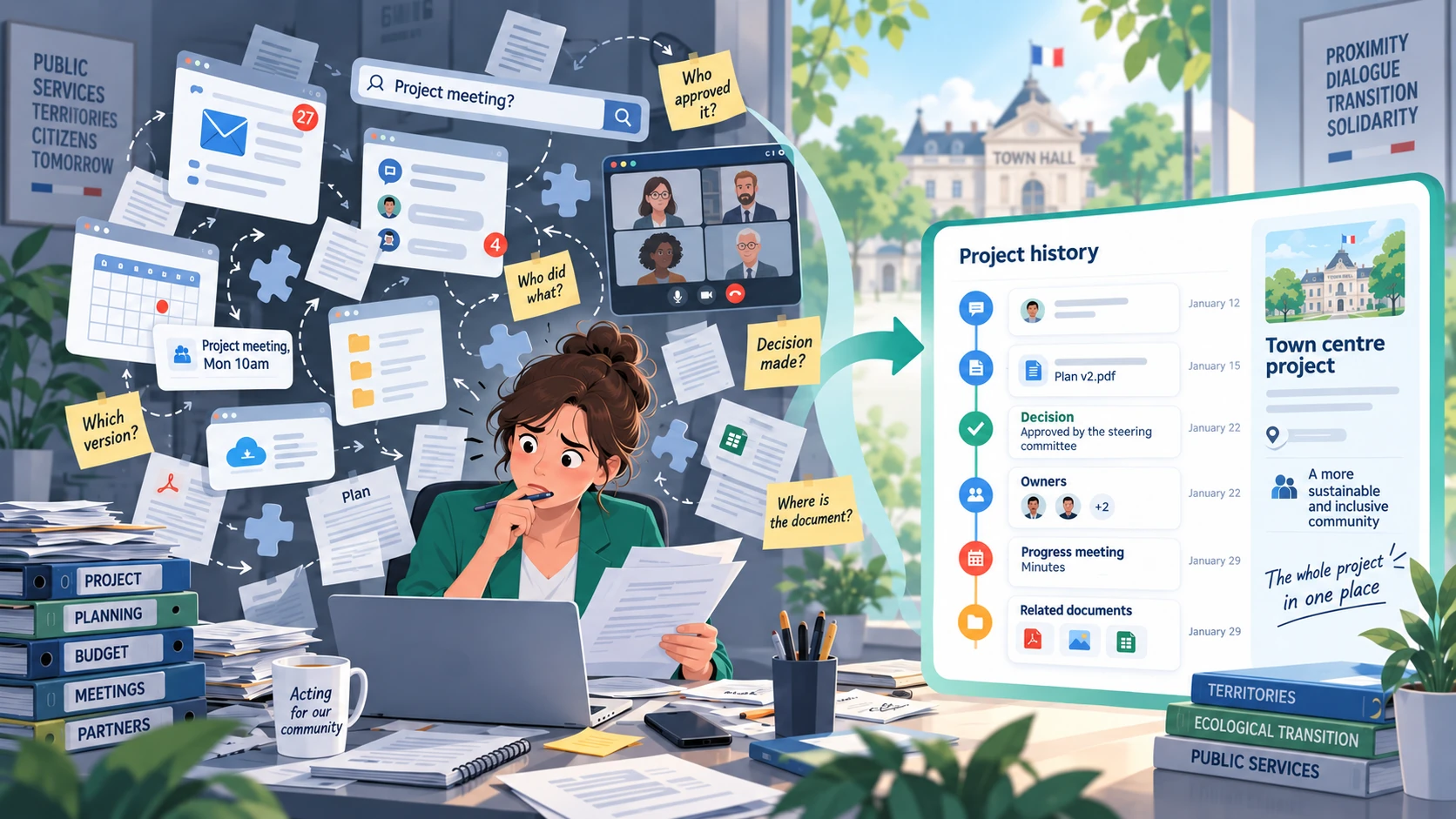
It's 9 o'clock.
You are resuming a project left the day before.
Before you can even move forward, you have to find the last exchange.
Was it in an email?
In Teams?
In a document?
In a task?
In the minutes of the last meeting?
You finally find the message.
But the document he was referring to is missing.
Then you find the document.
But one question remains: why was this version retained?
We must then return to the discussion which preceded it.
A few minutes pass.
Sometimes much more.
And you haven't produced anything yet.
You simply reconstituted the context necessary to start working again.
Part of our job now is to get back to work
This is probably one of the paradoxes of digital work.
We have never had so many tools to communicate, share, store and organize information.
And yet, we still devote a significant part of our time to finding this information.
Microsoft noted in its Work Trend Index 2023 that 62% of those surveyed felt they spent too much time searching for information during their working day. The study also found that 68% said they lacked uninterrupted concentration time.
The problem is therefore not only about receiving a lot of information.
It is having to find the right information, in the right context, at the right time.
Searching is only the first step
Research is the most visible part of the problem.
But she is not the only one.
Because finding a message does not necessarily mean understanding what happened.
Let's make a relatively simple decision:
“We are retaining version B of the plan. »
A few months later, finding this sentence is not always enough.
It is also necessary to understand:
- Why version B?
- Who proposed it?
- Who was to validate it?
- What document was examined?
- What objections had been formulated?
- What task followed this decision?
- And who was responsible?
The difficulty is therefore no longer only find information.
It consists of find his story.
Meetings sometimes serve to reconstruct what the tools can no longer tell
We obviously organize meetings to decide, create, arbitrate and work together.
But another category of meeting has gradually established itself in organizations:
the reenactment meeting.
“Where are we at”
“Who should take care of it”
“Did anyone have the answer to”
“What was the last decision to”
“Can someone resend the document to me at”
We then bring together five or six people in order to share what each person has in their own memory, their emails, their messages or their files.
In other words, human memory sometimes compensates for a fragmented digital memory.
This phenomenon is not anecdotal: Microsoft ranks ineffective meetings among the main obstacles declared to productivity.
Then comes the permanent change of context
Another cost is even less visible.
You are working on a project.
You open your email to find an exchange.
A new notification appears.
You consult it.
Then Teams.
Then a document.
Then your task manager.
A few minutes later, you should mentally return to your initial plan.
This is the context switch.
And it repeats itself all day.
The problem is not just the number of applications open.
Each change asks the brain to answer several questions again:
Where was I?
What was I looking for?
What was the context?
What was the next action?
Microsoft itself now describes increasingly fragmented work: its data indicates that Microsoft 365 users are, on average, interrupted every two minutes by a meeting, an email or a notification.
Each interruption seems small.
Added up over a day, they profoundly change the way we work.
“Work about Work”: working around work
Asana has popularized a particularly apt expression:
“Work about Work”
The work around work.
This is not the work we are actually supposed to produce.
This is all we need to do to be able to produce it:
- search for information,
- find a document,
- ask where a task is,
- coordinate people,
- update the tools,
- participate in certain meetings,
- find a decision,
- copy information from one place to another.
In his Anatomy of Work Index, Asana estimated that employees spent 58% of their day “work about work” and also noted several weeks of work lost each year in duplicated tasks and certain unnecessary meetings.
The number matters.
But the phenomenon is more important.
We have built a lot of tools to work with.
And we gradually created additional work to manage these tools.
The problem is perhaps less the work than its fragmentation
Why do we have to replenish so much?
Because the history of work is not always kept in the same place.
A project can have:
- a history in messaging,
- another in the chat,
- another in the documents,
- another in the tasks,
- another in meetings.
All these elements however concern the same story.
But they don't necessarily live together.
The employee must therefore rebuild the links.
- The message explains the document.
- The document results in a decision.
- The decision generates a task.
- The task provokes a new discussion.
When these elements are separated, the link between them is largely based on the memory of the people.
And when people change?
This is where the problem becomes even more obvious.
A collaborator leaves the project.
A new manager arrives.
Six months have passed.
Human memory disappears or fades.
Information always exists somewhere.
But we must reconstruct their logic.
This is why keeping the data is not enough.
We must preserve the story that links the data.
People can change.
The history of the project should remain.
What if we removed some of the reconstruction work?
It is precisely on this question that the architecture of FaceCollectivité.
We started from a simple principle:
organize before exchanging.
A project becomes a structured space in which exchanges are organized by subject.
In the face-to-face thread, targeted exchanges, tasks and documents remain linked to their context.
The General channel also allows communications that concern the entire project.
An exchange has an issuer.
A responsible recipient.
Possibly copying people.
A task can arise directly from this exchange.
A document can remain associated with it.
Information is therefore no longer just sent.
It is stored when it is created.
From the flow of information to the project logbook
This is what gradually allows us to constitute what we call at FaceCollectivité:
Project logbook.
The story is built gradually.
- Page after page.
- Exchange after exchange.
- Decision after decision.
- Document after document.
- Task after task.
Six months later, we no longer ask several people to mentally reconstruct what happened.
We can reread the history of the project.
And this difference may seem simple, but it profoundly changes the relationship with digital work.
Productivity may not be about working faster
For a long time, we tried to save a few seconds:
send faster,
respond faster,
share faster,
notify faster.
But the real gain may lie elsewhere.
No longer having to mentally redo what the system should have preserved.
- Search less.
- Less interrupting.
- Less ask.
- Less bring together people just to find out where the project is.
- Less rebuilding.
And find time for what really matters: